AGSE is a partner in the SCIFine project (Scientific Capacity through Inquiry for Foundational Impact and Networked Engagement) coordinated by MENTORTEC and funded by the Erasmus+ Programme under the Forward-Looking Projects – School Education action.
Assuming that the integration of STEM skills in the early stages of th educational path has become increasingly important in European education systems, the Project intends to promote scientific literacy and the development of STEM skills (Science, Techonology, Engineering and Mathematics) from pre-school through to the first cycle of basic education. It focuses on equipping educators and teachers to implement more effective teaching practices in the areas of science and mathematics, thereby contributing to improved student performance and the strengthening of basic literacy skills from the earliest stages of education, as well as raising awareness of this issue among school heads.
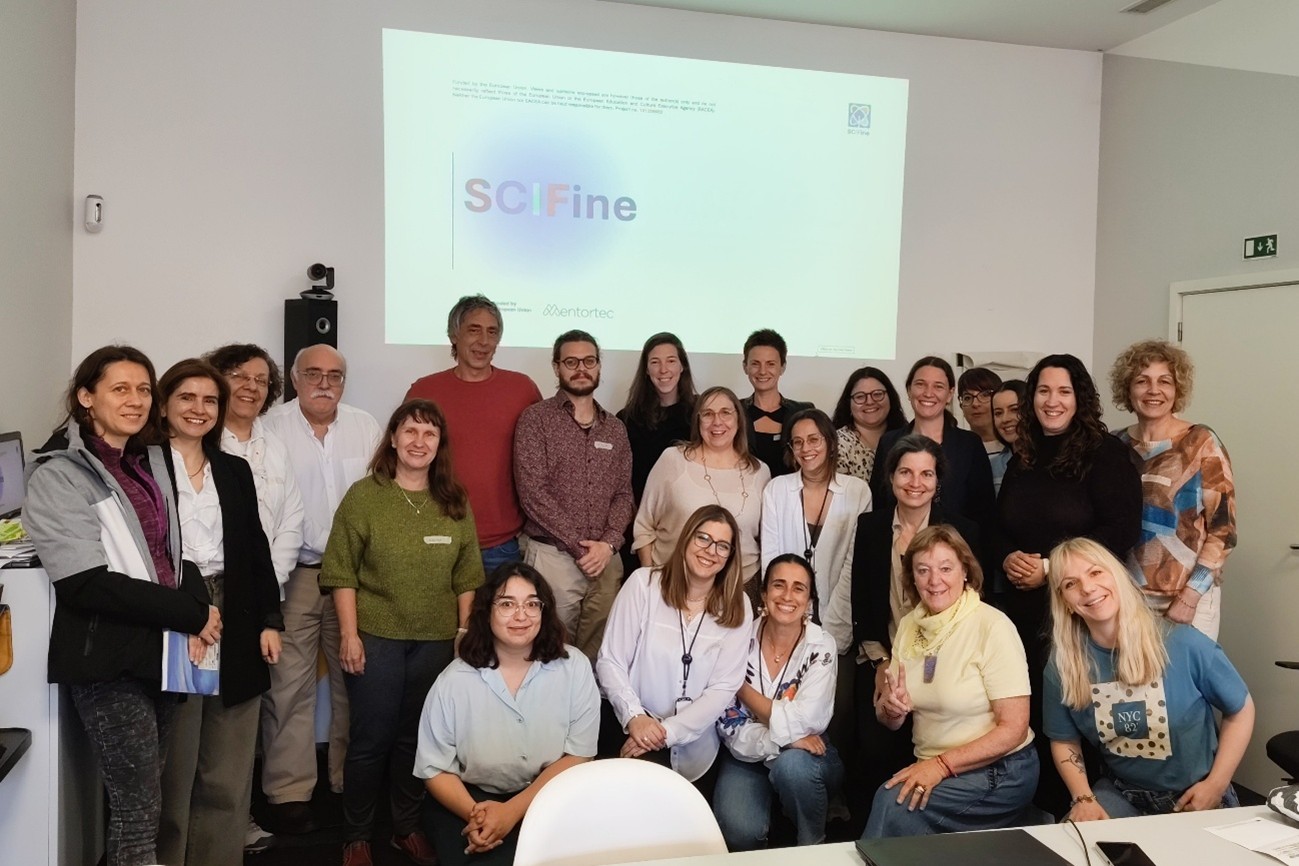
The project consortium, brings together 27 members from Higher Education Institutions, non-profit organisations, schools, and public bodies, from Portugal, Croatia, and Slovenia. Portugal, in Croatia e da SloveniaThe first face-to-face meeting of the consortium took place in Matosinhos on 5 and 6 May. In Portugal, in addition to Mentortec, the Polytechnic Institute of Santarém, AGSE (under the Ministry of Education, Science and Innovation) and INNOVEDU act as full partners. AGSE was represented by Dra. Lília Vicente and Dr. Fernando Alexandre from the Department of Human Resources and the Schools' Training Centres Network. Polytechnic Institute of Santarém, a AGSE of MECI and the INNOVEDU. AGSE was represented by Dr. Lília Vicente and Dr. Fernando Alexandre, from the Human Resources Department and the CFAE Network.
The consortium will help to establish a network of scientific schoolspromoting knowledge-sharing and cooperation between the educational community and science experts, with a view to boosting children's motivation, engagement and performance in STEM subjects.
To this end, it is important to strengthen the skills of school heads and other education professionals and to provide innovative teaching resources, with a view to tackling inequalities in access to high-quality educational practices and resources, as well as to promote closer links between schools and the community through the creation of regional STEM hubs.
Publicado em May 29, 2026 | Atualizado em June 1, 2026